Wildlife for Sale: An Oxymoron

Even when bred in captivity, wild animals retain strong natural instincts.
When animals are unable to express natural behaviors, live in their natural habitats, move around, have companionship, or be with their offspring, they exhibit signs of stress, such as:
-
illness
-
pacing
-
repetitive squawking
-
other repetitive behaviors
-
even self-mutilation.
Despite growing awareness that wild animals are better off not-as-pets, they are still illegally trapped, trafficked, bred, packed tightly, mishandled, and confined to pet stores and private collections their entire lives. These animals are doomed to go from one cage to another, suffering to death.
Featured Story: Spur the Tortoise
At The Animal Store, one would-be wild animal has spent more than three decades far from freedom, confined to an unnatural enclosure.
Spur's Reality:
Life Span: 50-150 Years (Longer Than the Human Maximum Lifespan):
-
At ~40 y.o., Spur's confinement hasn't even reached its halfway point yet
-
Although Spur isn't for sale, baby sulcata tortoises are sold at The Animal Store– non-native, and unfit for Illinois' erratic weather
-
For $300, anyone can sign up for a 150-year commitment
-
Likely Spur's hatchlings; her species does not need a male to lay eggs
-
Prolonged Confinement for an Animal Who Did No Wrong:
-
Spur's hard body crashes as she struggles to escape many times per day (watch the video)
-
Spur has nowhere to regulate her own body temperature
-
Her space is 4x her body length
-
She is not for sale; used as a window prop; for-display-only
-
Subjected to radio-, store-, people-, animal-, traffic-noise (on Touhy right off 94), plus light pollution: 24/7, 365
-
The Law Is on Spur’s Side. Village Officials Stand By Her Ongoing Confinement.
-
Spur was most likely stolen from her home in Africa- a victim of the exotic animal trade.
-
Visitors are encouraged to touch her, and feed her scraps from their own kitchen. This is a public health issue.
-
Enforcing humane law is not radical. It is responsible governance.


What Spur Needs (And Deserves!):
In the Wild, Sulcata Tortoises Roam for Miles Each Day.
-
"Sulcata tortoises will tunnel under and climb wire mesh fences, as their escape attempts never cease.
-
Adults in general love to dig. Sulcatas are one of the three true tunnel digging tortoise species.
-
Rocks, tree trunks, boulders, and roots create obstacles and mental stimulation." (Spur has none of these things.)
-Chicago Exotics Animal Hospital
More Facts:
-
"The African spurred tortoise...is the third-largest species of tortoise in the world,
-
the largest mainland species of tortoise,
-
the only species [still in existence] in the genus Centrochelys."
-Animalia
Spur's Life Deserves to Be Honored.
There's Still Hope:
-
Veterinary professionals agree, Spur does not appear "too sick to travel" (as the owner of The Animal Store claims).
-
CAA has secured sanctuary for Spur at the Desert Oasis Turtle and Tortoise Sanctuary (DOTTS) in Arizona; much more akin to her native home.
-
Spur would have basic necessities– freedom from confinement.
-
the ability to live outside,
-
feel sunshine,
-
a fresh breeze, and
-
have the freedom that was stolen from her.
-
-
CAA would provide the safe transport for Spur at no charge to The Animal Store, The Village of Lincolnwood, nor its residents.
"Adults in general love to dig. Sulcatas are one of the three true tunnel digging tortoise species."
-Chicago Exotics Animal Hospital
The Illegal Wildlife Trade
Pathogens
"Traded mammals are about 1.5 times as likely to be sources of human diseases than non-traded animals, the researchers report in Science. Crucially, the longer humans have been interacting with a species, the more viruses we have in common — especially when dealing with illegal animals and live markets."
- Colin Carlson, a disease ecologist at Yale University
It's Up To Lincolnwood's Mayor and Trustees
Cook County already has the ordinances, to prevent the confinement of wildlife in commercial settings. Village officials have acknowledged that the enforcement of these laws (and even parts of its own village code) has been waived by choice — not due to lack of power. Please urge officials to re-vote to protect the vulnerable; the public; and countless animals suffering in unnatural environments.
Wild Animals as Pets Put Public at Risk
Another major concern is public safety: wild animals may escape or be released, potentially harming the public or introducing zoonotic diseases.
Example:


The post reads,
"Chicagoland Exotic Animal Rescue - CLEAR
***COURTESY POST***
FOUND STRAY
Independence Park, Chicago, IL
Red-tail Boa
February 24, 2026
Please share, spread the word and call the Chicago Park District at 773-478-3538 if this is your baby!****
NOTE: CLEAR does NOT have this animal in custody, nor are we responsible for them at this moment in time.***"
The Animal Store, in Lincolnwood, Illinois


The Bigger Wildlife Problem
It's not just about Spur. (But if it were, it would all still be worth it.)
The following is a list of species reportedly or potentially sold (past or present) at The Animal Store.
Wild Species:
Small Mammals
Chinchilla
Mouse
Rat
African pygmy hedgehog
Madagascar Tenrec
Sugar glider
Degu
Prairie dog
Siberian chipmunk
Flying squirrel
Skunk
Virginia opossum
Fennec fox
Reptiles
Leopard gecko
Bearded dragon
Crested gecko
Ball python
Corn snake
Kingsnake
Milk snake
Garter snake
Red-eared slider
Russian tortoise
Box turtle
Blue-tongued skink
Green iguana
Uromastyx
Boa constrictor
Red tegu
Sulcata tortoise
Amphibians
Pacman frog
Tree frog
Axolotl
Birds
Budgerigar
Cockatiel
Lovebird
Canary
Zebra finch
Society finch
Diamond dove
Green-cheek conure
Sun conure
Quaker parrot
Parrotlet
Cockatoo
African grey parrot
Blue-fronted Amazon
Red-fronted parrot
Eclectus parrot
Macaw
Gouldian finch
Java sparrow
Society munia
Ring-neck dove
Rock pigeon
Mynah bird
Rose-ringed parakeet
Small corvid
Freshwater Fish
Goldfish
Betta
Guppy
Molly
Platy
Swordtail
Neon tetra
Cardinal tetra
Zebra danio
Barb
Rainbowfish
Corydoras catfish
Kuhli loach
Clown loach
Oscar
Texas cichlid
Blood parrot cichlid
Common plecostomus
Pictus catfish
Discus
Giant gourami
Bala shark
Arowana
Pacu
Bichir
Zebra pleco
Titanic pleco
Redtail catfish
Datnoid
Arapaima
Colombian shark catfish
Marine Fish
Clownfish
Damselfish
Gobies
Blennies
Wrasse
Marine angelfish
Butterflyfish
Tang
Pufferfish
Seahorse
Invertebrates
Hermit crab
Tarantula
Emperor scorpion
Praying mantis
Stick insect
Rhinoceros beetle

Hedgehogs
Hedgehogs commonly sold in the pet trade are captive-bred, but their instinctual behaviors have been shaped by their wild ancestors. They are nocturnal, solitary animals who require warm, temperature-controlled environments to prevent hibernation attempts, which can be dangerous or fatal in captivity. Hedgehogs need space to roam and forage, quiet surroundings, and gentle, knowledgeable handling. Stress from improper temperatures, frequent handling, or confinement can lead to illness, fear responses, and injury.
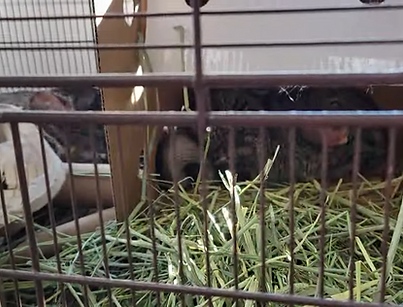
Chinchillas
Chinchillas are prey animals adapted to cool, dry climates and are extremely sensitive to heat and humidity. They require strict temperature control, access to regular dust baths to maintain healthy fur and skin, and ample space to jump and move. Chinchillas are easily stressed by noise, handling, and environmental changes. Inadequate housing, improper temperatures, or lack of enrichment can result in overheating, fur loss, injury, and chronic stress.

Sugar Gliders
Sugar gliders are nocturnal, highly social animals who naturally glide distances of 100–150 feet between trees and range across several acres each night while foraging with their colony. Caging them prevents gliding, social bonding, and natural movement, often resulting in depression, stress behaviors, and self-harm.

Birds
Parrots, cockatoos, African greys, macaws, and other birds are highly intelligent, social birds who naturally fly miles each day, forage continuously, live in complex social groups, and can live for decades. In captivity, they are typically caged for most of their lives, deprived of flight and flock interaction. This commonly results in severe psychological distress, including feather plucking, self-mutilation, and chronic anxiety. "The US Department of Agriculture has failed to protect birds under the AWA for almost two decades despite its legal obligation to do so. In 2002, the AWA was amended to include birds not bred for use in research. The agency failed to develop standards and is now under court order to draft rules for birds in the pet trade or exhibited, as well as wild-caught birds used in research." -World Animal Protection US

Opposums
One needs a license to own a Virginia opossum in Illinois, so I wonder if The Animal Store requires proof of these licenses before selling opossums. Let's remind Lincolnwood officials that Virginia opossums are definitely 'naturally wild' regardless of how/where they were born, raised and/or stolen from nature.


The Simple Solution
Spur’s suffering is not inevitable. Enforcing humane law is not radical. It is responsible governance.
The Village of Lincolnwood has the power to protect wildlife, with two opportunities each month (at every board meeting) to put this item back on their agenda and vote to implement this common-sense law, without hiring anyone new, or writing any new legislation.





Documented U.S. Cases and Midwest Evidence
Federal prosecutions and public records show that the sale of wildlife in the U.S. extends far beyond pet stores, involving organized trafficking networks, online marketplaces, and repeat violations of conservation laws.
Midwest; Birds & Reptiles:
-
Chicago as a Trafficking Hub: Cases linked to O'Hare International Airport identify it as a major entry and exit point for illegal wildlife shipments.
-
Songbird Trafficking (“Operation Trap”): Federal prosecutions in Illinois and Indiana involve the illegal trapping and sale of protected songbirds such as indigo buntings and northern cardinals.
-
Tropical Bird Smuggling (Chicago Area): Northern District of Illinois cases document the import and resale of protected species like keel-billed toucans in the Chicago suburbs.
-
Raptor Trafficking (WI/IL): Federal charges have been filed for the illegal sale and transfer of hawks and falcons without required permits.
-
Turtle Laundering Networks: Records in Illinois and Missouri show wild-caught turtles falsely labeled as captive-bred for export to Asia.
-
Venomous Snake Sales (IN/IL): State investigations and raids have uncovered illegal sales of cobras and vipers through online forums and swap meets without permits.
-
Reptile Trafficking (2025): In December 2025, a Chinese national was sentenced to prison for trafficking protected reptiles; earlier that year, Paul Jacob Elliott Sommers was sentenced to six months in prison for operating a four-year scheme importing wildlife from Mexico for resale in the U.S.
-
Monkey Torture Videos (2025): Katrina D. Favret (November 2025) and Nicholas Dryden (March 2025) pleaded guilty to conspiracy involving the creation and distribution of “animal crush” videos depicting extreme abuse of monkeys.
-
Whale and Bird Parts (2025): A Maine man pleaded guilty in September 2025 to illegally trafficking protected whale and bird parts in violation of federal law.
-
Exotic Birds and Monkeys (2025): In February 2025, a trafficking ring leader was sentenced to prison for arranging online sales of federally protected keel-billed toucans and Mexican spider monkeys.
-
Turtle Trafficking (2024): Russell Milis was indicted for trafficking approximately 400 turtles (valued at $700,000) to Hong Kong and China.
-
High-Profile Trafficking Case (2025): Bhagavan "Doc" Antle was sentenced in July 2025 on federal wildlife trafficking and money laundering charges.
These cases are documented through federal databases such as the PACER, enforcement summaries from the U.S. Department of Justice Environment and Natural Resources Division, and press releases from the U.S. Fish and Wildlife Service and National Oceanic and Atmospheric Administration.
Taken together, these records demonstrate that the sale of wildlife is not isolated or rare, but part of a persistent and well-documented illegal trade operating at both national and regional levels.
Banning Retail Sales of Wild Animals
(World Animal Protection US)
"It might be easier to understand why wild animals like monkeys, kinkajous, or tigers belong in the wild.
But reptiles, amphibians, and birds also have complex inner lives even if their facial expressions or vocalizations are not as easily understood by humans.
These animals are sentient beings who feel pain and a wide range of emotions including anxiety, fear, pleasure, and excitement.
Wild animals kept as pets are unable to fully engage in their natural behaviors like exploring, living in family structures, foraging, or — for some species — even regulating their body temperature."
-World Animal Protection US
How to Help
Lincolnwood officials have the power to immediately stop and prevent continued suffering, rather than permit it. The mayor and trustees of Lincolnwood can align with home-rule authority and the modern humane standards already in place. Without hiring anyone new. Without writing any new legislation.
You can help by:
1. Calling or emailing the Mayor. Please request a response.
2. Giving a public comment at a Lincolnwood Village Board meeting. If you'd like, we can go with you. Please get in touch for more details.
3. Share this page widely.
To: jpatel@lwd.org
CC:
jpatel@lwd.org,jhalevi@lwd.org,cmartel@lwd.org,cklatzco@lwd.org,gherrera@lwd.org,asargon@lwd.org,administration@lwd.org,info@allianceforlincolnwood.com,info@lincolnwoodchamber.com,jan.schakowsky@mail.house.gov,info@senatorram.com,info@kevinolickal.com,Josina.Morita@cookcountyil.gov,Chicagoallianceforanimals@gmail.com
Lincolnwood Issues a Statement
The Village’s issued this statement: “Sale of Exotic Animals in the Village”. Its own statement makes clear that this is not a matter of legal limitation—it is a matter of choice. The Village has the laws, discretion, and authority to act, yet it has chosen to waive enforcement. Below, we address each of their justifications to evade the law.
“The Village waived enforcement legally”
Yes — and that is precisely the problem.
Home-rule authority is meant to:
-
protect residents
-
uphold community standards
-
prevent harm
It is not meant to be used to create exceptions that allow prolonged suffering for a single business.
Discretion should be used to protect the vulnerable — not exempt them from protection.
Laws


Why This Matters to the Community
-
Reduce the risk of zoonotic disease (hundreds of wild species are sold there)
-
Protect local ecosystems from non-native species
-
Prevent injuries from frightened or mishandled animals
Please Urge The Animal Store to Release Spur to Sanctuary
Subject: Please Allow Spur to Go to Sanctuary
Dear Kenneth Bearman,
Please allow Spur to be transferred to a sanctuary. Desert Oasis Sanctuary in Arizona is ready to receive her, and she is healthy enough to be moved safely. We are committed to raising funds to support her transfer.
We urge you to prioritize her well-being, adopt out other animals in your care, and stop breeding animals for profit. Choosing humane outcomes reflects both responsibility and compassion.
Thank you for considering this.
Sincerely,
[Your Name]
Phone: 847-675-5133
Email:
Spur@theanimalstore.com
Social:
https://x.com/KennAnimal
https://x.com/Theanimalstore
https://www.instagram.com/the_animal_store
https://www.facebook.com/TheAnimalStorePets
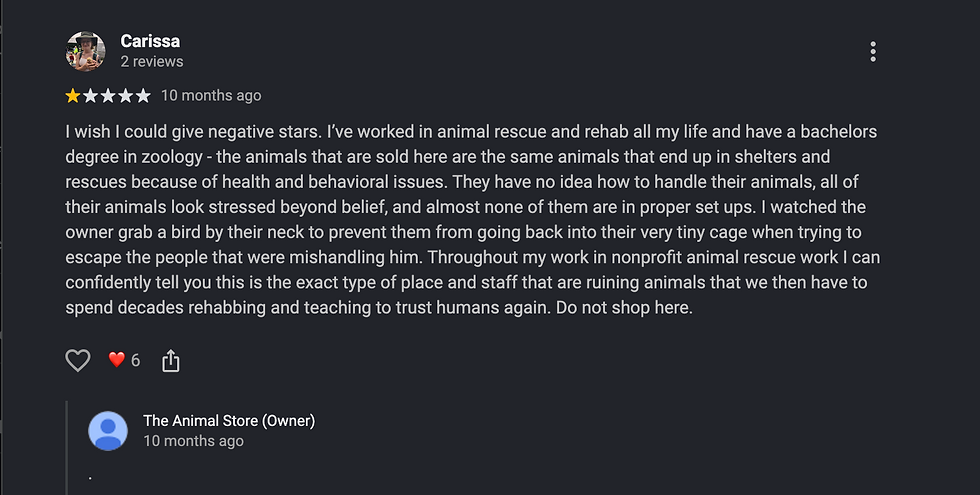
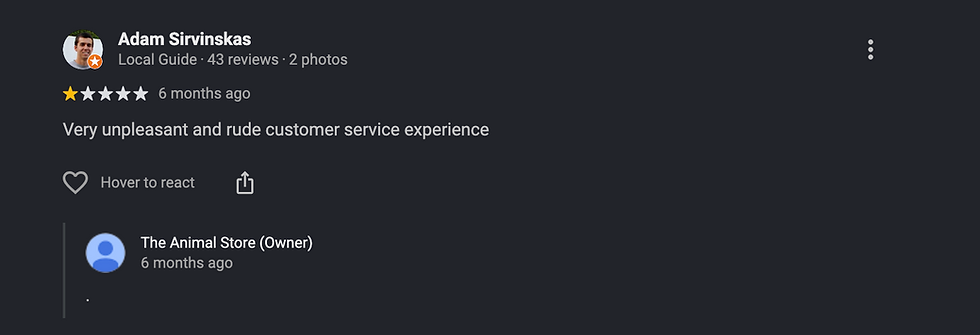
Leave a Review:
Google
Yelp

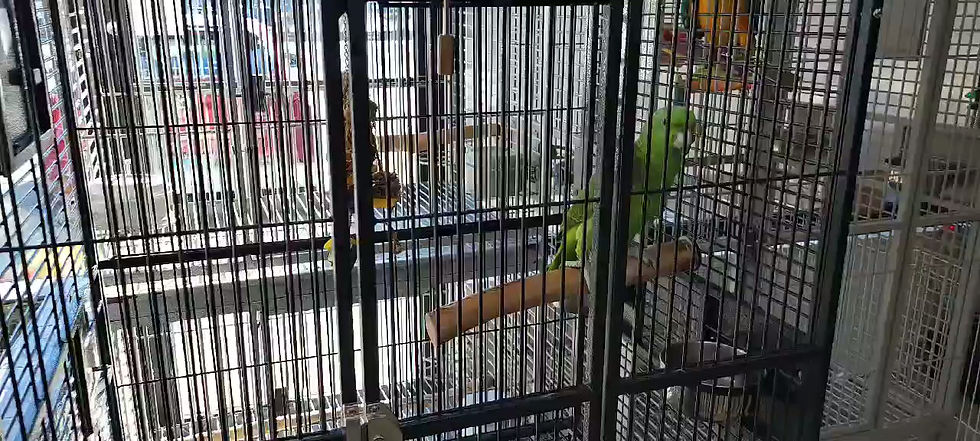
Confinement doesn’t only limit movement — it causes chronic stress, illness, and trauma.
Wild animals DO NOT belong in cages.
Wild animals DO NOT make good pets.
Wild animals DO NOT belong in our homes.
Wild animals DO belong in the wild.
Voices Dismissed, Harm Continues
Concerned residents and animal welfare advocates from surrounding communities have raised issues about the confinement and sale of wildlife, lack of accountability from The Animal Store, non-native species threatening public safety, and other animal welfare concerns originating in Lincolnwood.
Despite these concerns, Lincolnwood officials have not met—nor corresponded with—advocates.
Speakers report that public testimony is deliberately delayed until the end of meetings—after attendees are encouraged to leave—and that portions of audio from recorded town hall meetings were unlawfully censored. In the linked recording of CAA’s July public testimony, the volume has been turned down so low that it is barely audible. This is how community voices are silenced.
Linked to timestamp:
Censored Public Comments
Village Board Meeting June 3, 2025
The Village lacks transparency, but Spur’s unlawful confinement is plainly visible.
Why hasn’t this issue been resolved by officials?
Village officials have the authority to revisit this issue and enforce existing standards. This is a matter of leadership and enforcement.
Does this law limit my choices?
Nope! You can still adopt small animals from shelters and licensed rescues. The law targets the commercial sale of wildlife, protecting wild animals from confinement, and ensuring they thrive in appropriate environments where they can roam safely and naturally-- with space, freedom, and proper care. This is also about preventing animal, public, and ecosystem harm caused by unregulated, profit-driven retail sales.
Why focus on animals when people are suffering?
Animal exploitation often creates human consequences — public-health risks, environmental damage, and long-term community costs. If we waited for all humanitarian problems to be fixed, no one would be talking about the animals (as we witness in LW Village Meetings).